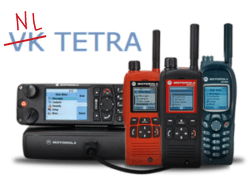
Amateur Tetra radio is here, and has active participation in many counties around the world.
If you’re looking at how to get started with Amateur Tetra Radio, read on.
What is Tetra Radio?
Terrestrial Trunked Radio (TETRA; formerly known as Trans-European Trunked Radio), a European standard for a trunked radio system, is a professional mobile radio and two-way transceiver specification. TETRA was specifically designed for use by government agencies, emergency services, (police forces, fire departments, ambulance) for public safety networks, rail transport staff for train radios, transport services and the military. TETRA is the European version of trunked radio, similar to Project 25.
TETRA is a European Telecommunications Standards Institute (ETSI) standard, first version published 1995; it is mentioned by the European Radiocommunications Committee (ERC)
(source: wikipedia)
What is the difference between TETRA, DMR, P25 and other digital radio modes?
TETRA and P25 (Project 25) are both used worldwide for public safety and private sector radio networks, but they differ in technical features and capacity. DMR and several other digital standards cover the lower-cost and commercial end of the market.
TETRA (ETSI standard)
- Optimised for densely populated areas.
- Fits four time slots (four communication channels) into each 25 kHz carrier, which uses spectrum efficiently.
- Supports full-duplex voice, data and messaging.
- Generally not suited to simulcast or the VHF band, although some vendors have added both to their TETRA platforms.
P25 (APCO Project 25)
- Optimised for wide-area coverage in sparsely populated regions, and supports simulcast.
- Its data capability is more limited than TETRA’s.
- Phase 1 works in 12.5 kHz channels in analogue, digital or mixed mode.
- Phase 2 moves to a two-slot TDMA structure within 12.5 kHz channels.
DMR (Digital Mobile Radio, ETSI standard)
- Uses two-slot TDMA in 12.5 kHz channels, so two voice channels share one carrier.
- Has three tiers:
- Tier I is licence-free, low-power use.
- Tier II is conventional licensed systems.
- Tier III is trunked systems.
- Works on VHF and UHF and supports simulcast.
- Equipment is generally cheaper than TETRA or P25, which makes it popular in industry, transport, utilities and security.
- Its data and security features are more basic than TETRA’s.
- It is less established for national public safety networks.
Other digital modes
Broadband (LTE/5G mission-critical push-to-talk): Not a narrowband radio standard. It is increasingly deployed alongside TETRA and P25 for high-speed data, video and location services. Currently, P25 deployed to more than 53 countries and TETRA deployed to more than 114 countries.
NXDN: A Kenwood/Icom standard using FDMA in 6.25 or 12.5 kHz channels. It is spectrum-efficient and low-cost, and is mostly used in commercial and some public safety systems.
dPMR: An ETSI standard using FDMA in 6.25 kHz channels, mainly for small commercial users.
TETRAPOL: A proprietary FDMA standard using 12.5 kHz channels. It is used by some European public safety agencies, mainly in France.
How do I get started using Tetra as an amateur?
First, you’ll need a Tetra radio that’s capable of transmitting and receiving within the licensed ham bands within your country. This is typically around 430-440mhz.
I’ve put together a Detailed Radio Buying Guide which covers what radios to consider, how they work, and some common tips and tricks to ensure you get the right radio.
If you’re in the footprint of an existing gateway, simply program your radio and start talking on the network!
If you’re not in the coverage footprint of an existing gateway, why not Build Your Own! Not only will you give yourself access to the Tetra network, you’ll also be expanding the network for all to use.